
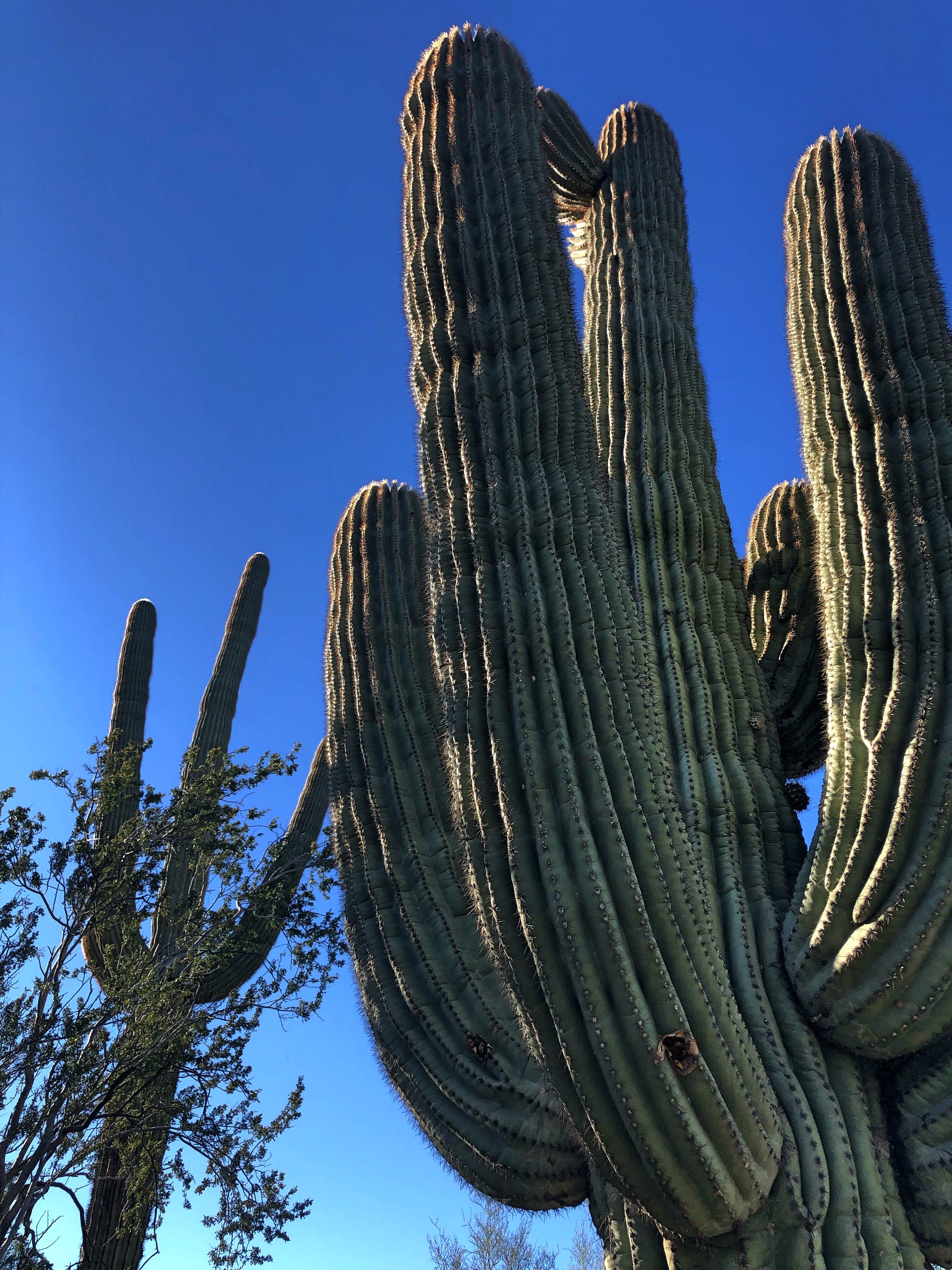
When I was a kid, we would sometimes hear the distant barking and howling of dogs from the east end of our village. Like a wave, the noise would flow across the community, peaking in volume when our own dogs would join in, and then dissipating rather quickly as we lived near the northwest edge of town.
Sometimes, the cause ended up being the siren of a racing ambulance on the way to the small village hospital irritating the dogs, but more often than not, there seemed to be no noticeable reason for the commotion. When that was the case, my grandmother would stop whatever she was doing and let the event build and break, then she would close her eyes briefly and take a deep breath. She told me the dogs were mourning the loss of someone.
We recently had another death in our Salt River tribal community. She was another young lady - though this time the death was an entirely unexpected natural event. She was a caregiver who worked with dementia patients at the ends of their lives. She was a joyful and gentle soul, and she will be sincerely missed.
As the deceased young lady was being escorted to her grave from the Maricopa “Cry House” at sunset, a pack of coyotes began yelping and crying loudly nearby. It was impossible not to notice, and it was recognized at the graveside when a speaker remarked that when a good person dies in our community, even the animals know and mourn.
Nature and myth, fact and fancy, are the narratives of philosophy and religion. One, philosophy, attempts to find truthful meaning in a profoundly complex world whose extent falls easily beyond our limited vision and understanding. Religion is, in my opinion, a people’s way of attempting to organize and identify meaningful truth in the composition of the world and of life’s challenges and elations.
I have always had a philosophical mind - trying to make sense of the actions of my fellow man and trying to understand purposeful motivations and ideal objectives, but I also always loved the imagery, depth, and resonant value of mythic stories, regardless of their origin.
A great deficiency in the sharing of myth, however, is the inability to effectively translate a told story from its original language and pure meaning to an understandable and evocative more-commonly spoken tongue. O’odham is a relatively simple spoken language, but it is merely the limited expression of the universally byzantine human mind.
Years ago, I commented on Tom Ryan’s love of coyotes howling among the saguaro at sunrise (maybe on Instagram?). I shared a brief excerpt of the O’odham story of the first sunrise in creation and Earth Doctor comforting excited and crying Coyote with the comment, “Didn’t we make the sun together and speak with him?”
The story is longer, and often, maddeningly, not quite linear, but the upshot is that Earth Doctor, Buzzard, and Coyote worked together to bring light to darkness. Earth Doctor fashioned the essential form of the sun, but Buzzard and Coyote prayed and willed with Earth Doctor to cause the generation of heat, light, and life from the sun. The sun became aware and could feel all life that ever was and ever will be within him and was overwhelmed, but gave thanks to Earth Doctor, Buzzard, and Coyote for bringing him into existence.
When it came time to name the sun, there was an argument. Coyote was insistent that the sun be named simply “Țonig,” or “Light,” whereas Earth Doctor was already prepared to grant the name “Țash,” or “sun, day, calendar, or time,” to their new creation. The sun was placed in the sky, first in the north, then the east, then the south, and then in the west, and it kept falling, so finally Earth Doctor held the sun straight up in the sky and suggested a short break to allow everyone to sort out the situations and conceive of possible solutions. Coyote, of course, took the break a little bit too much to heart and decided to take a short snooze. The implication is definitely that Earth Doctor planned, or even maybe encouraged, Coyote’s nap, and after Coyote was asleep, took the opportunity to do what he felt he had to. (Buzzard is rather quiet throughout the story, but it’s inferred that he was consistently in silent agreement with first born Earth Doctor and knew exactly what was to necessarily happen.)
Coyote opened his eyes to see Earth Doctor take the sun and throw it hard toward the western sky. Coyote was incensed and ran, barking and howling in anger, to Earth Doctor. As the sun fell beyond the western horizon, Coyote knew the sun had been formally named Țash and the cycles of existence had begun, night and day, light and dark, hot and cold, life and death, but in that moment, Coyote was, above all else, scared. They were all now living within the movement of time - the past was unchangeable, and the future was fearfully unknown.
Coyote cried as the sun set then settled, with all the courage he could muster, into the dark and cold he had only ever known of existence. Only a few hours later, though, Earth Doctor convened the creators and looked to the east. As the sunrise became brighter, Coyote began crying again. He was sad for the creation of time - whatsoever gained will inevitably now be lost, but he was also happy - happy to see, to feel warmth, to know the love of this brothers, and to imagine the infinite love that could yet be welcomed to this earth as the ultimate gift of dynamic creation and the irresistible push of time from now on and until forever.
Buzzard spread his wings and breathed deeply before taking flight to appreciate the world’s first sunrise from high up. Earth Doctor sat next to Coyote and comforted him. Earth Doctor acknowledged Coyote was right. There was an alternative - an existence of eternal light, but it would never, without adversity and success, realize anything beyond a lonely, limited mere “existence.” Earth Doctor looked at Coyote and whispered, “Didn’t we make the sun together? Didn’t we speak with him and hear him? Didn’t we see the possibilities rush forth from the sun’s light and words? Didn’t we see life, know it, and want to see more?”
Earth Doctor went on, “Now we may all witness this beginning. This day will end - as all days now will forever end, but passing night, the sun will return again and again. We may be blessed with an infinite number of inspiring sunrises - and resilient sunsets - and not one will ever be the same in appearance or feeling.”
“All beginnings now have ends, but every end possesses another beginning in this great cycle of life now actively churning out the new, disposing of the old, and constantly, constantly renewing.”
“We will set aside a land of eternal light ‘beyond the sunrise’ for the eventual afterlife dwelling of all the spirits of the living not yet born, but for now, at the beginning of time, we pause and recognize that the purpose of life is to live well, to compel peace and to pursue harmony. It is our privilege, in lives well lived, to encourage virtue and beauty, to care for all life, and to actively improve, to the best of our ability, whatever we may receive during our short, swift time in this world.”
What an incredible story.
However, I think the thing that most stood out for me was the crying of the coyotes for the passing of the young woman. Animals are such sentient beings. Thanks, Hans.
I love this story